Ohio Energy Report: April 2026
Ohio Energy Leadership Summit to Take Place on June 16, 2026 in Cleveland
The inaugural Ohio Energy Leadership Summit: The Definitive Commercial & Industrial Utility Rate and Energy Strategy Conference will take place on Tuesday, June 16 at the Hilton Cleveland Downtown (100 Lakeside Avenue East, Cleveland, Ohio 44114).
The conference is scheduled to kick off at 8:30 AM and conclude at 6:00 PM. It will feature keynote perspectives, executive utility panels, and focused breakout sessions covering critical topics including grid reliability, distribution investments and rate cases, PJM market developments, natural gas supply trends, and strategies for managing energy costs in an evolving regulatory environment.
The program is designed for commercial and industrial energy consumers and is presented by the Ohio Energy Leadership Council, with sponsorship support from BakerHostetler and Dynegy (powered by Vistra).
Brakey Energy team members will be participating in three workshops or interactive panels during the conference.
You can view the full agenda, speaker lineup, and register through the conference event page. Brakey Energy clients and members of the Ohio Energy Leadership Council will receive complimentary registration. Other large energy users are able to access discounted registration. If you’re interested in attending, feel free to reach out to Catherine Nickoson for the registration code.

AEP Ohio’s New Base Rates Went Into Effect April 10
On April 1, 2026, the PUCO issued its Opinion and Order in AEP Ohio’s May 2025 Base Distribution Rate Case (Case No. 25-392-EL-AIR et al). In its decision, the PUCO adopted the join stipulation and recommendation in the case that was filed on January 7, 2026. The settlement established a return on equity of 9.84% and a base distribution revenue increase of approximately $11 million. This is a fraction of the $97 million that AEP Ohio sought in its Application.
Costs previously recovered through AEP Ohio’s Enhanced Service Reliability Rider (ESRR), Distribution Investment Rider (DIR), and Economic Development Cost Recovery Rider (EDCRR) were rolled into recovery through the utility’s base distribution rates. Therefore, although base distribution rates increased for General Service customers, the ESRR, DIR, and EDCRR rates decreased. The new base distribution rates that went into effect on April 10 are summarized below according to rate schedule.
Table 1. Base Distribution Rate Updates for Non-Demand Metered GS-1 Customers

Table 2. Base Distribution Rate Updates for General Service Secondary, Primary, and Transmission Customers
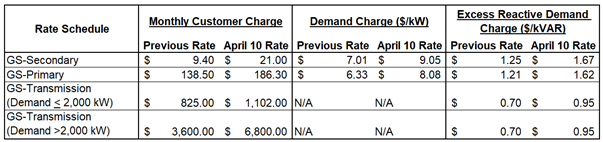
Data Center Tariff (DCT) customers will be subject to the new base distribution rates in addition to a new $20,000 per month supplemental charge for DCT customers served at Transmission voltage. This is a supplemental charge that will not apply to existing load, is not a base distribution rate, and will not be included in the calculations for rider charges billed on a percentage of base distribution rates.
As part of the approved settlement in the case, AEP Ohio will also refund approximately $105 million to customers over an 18-month period as a result of the Tax Cuts and Jobs Act, contributing to a net revenue decrease of $58.7 million.
If you are an AEP Ohio customer and would like to better understand how your distribution costs have been impacted through this rate case, please contact Kate Emling.
Ohio Supreme Court Rules on Landmark Submetering Case
On April 22, 2026, the Ohio Supreme Court (“the Court”) issued its Slip Opinion In re Complaint of Ohio Power Co. v. Nationwide Energy Partners, L.L.C. The Court’s decision fundamentally reshapes how electric submetering is treated in Ohio and has important implications for landlords, tenants, and commercial/industrial (C&I) customers.
In its ruling, the Court concludes that third-party submetering companies, like Nationwide Energy Partners (NEP), are “public utilities” under Ohio law because they purchase electricity and resell it directly to end users, namely tenants.
The Court rejected the prior position of the PUCO, which had found that submetering companies were not utilities and therefore not subject to regulation. Instead, the Court applied a plain-language interpretation of Ohio statutes and concluded that: (1) tenants are “consumers” of electricity, even in submetered properties, (2) submetering providers are “engaged in the business of supplying electricity” because they buy, price, bill, and control electric service delivery, and (3) as a result, these companies fall under PUCO jurisdiction and must comply with utility regulations.
This decision closes a long-standing regulatory gap by bringing large-scale submetering companies under PUCO oversight. For Ohio’s energy market, it introduces greater consumer protection and regulatory clarity, but also increased compliance obligations for landlords and third-party energy providers. C&I customers pursuing non-traditional energy structures, such as behind-the-meter energy solutions, microgrids, or energy resale arrangements, should closely evaluate how this expanded definition of a public utility could affect their strategies going forward.
The case was remanded back to PUCO to determine how regulation should be applied and to revisit related issues, including service territory rights and certification requirements. We will reach out to our impacted clients once the PUCO issues regulatory clarity. If you have any questions about how you may be impacted by this recent ruling, please contact Katie Emling.
Residential Corner
Sky-high capacity prices coupled with geopolitical turmoil has kept residential rates at the highest levels in recent memory. We recommend customers with an approaching contract expiration migrate to a 12-month offer with AEP Energy for 9.39¢/kWh.
Regarding natural gas, Brakey Energy has long viewed the distribution utilities’ Standard Choice Offer (SCO) as a prudent default strategy for supply. However, this approach can produce volatile bill outcomes—like the wild ride many customers experienced during the extreme cold earlier this winter. With natural gas settlement prices easing, many of our friends on the SCO can now safely unbuckle their seatbelts, at least until we need to strap in again next winter.
Natural Gas Market Update
The NYMEX price for April settled at $3.095 per Million British Thermal Units (MMBtu) on March 27, 2026. This price is up 4.2% from the March 2026 price of $2.969 per MMBtu. This settlement price is used to calculate April gas supply costs for customers that contract for a NYMEX-based index gas product.
The graph below shows the year-over-year monthly NYMEX settlement prices for 2022, 2023, 2024, 2025, and 2026 year to date. Prices shown are in dollars per MMBtu of natural gas.
Figure 1: NYMEX Monthly Natural Gas Settlement Prices
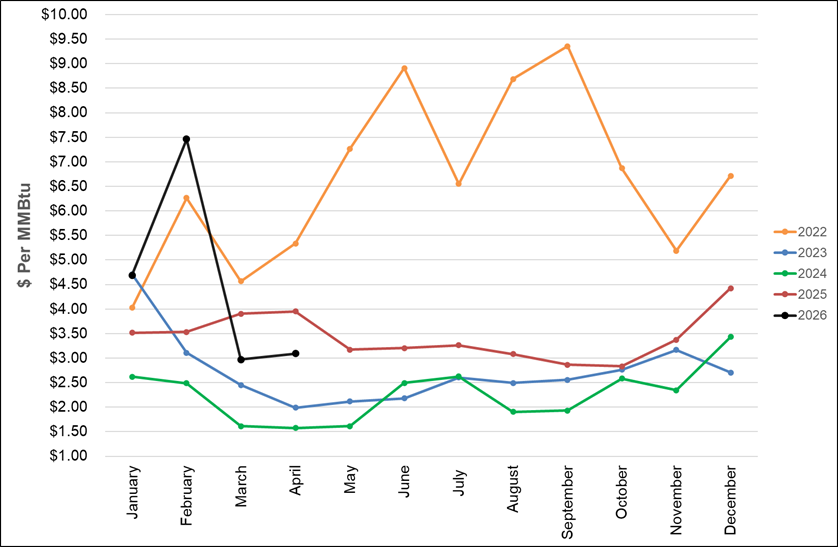
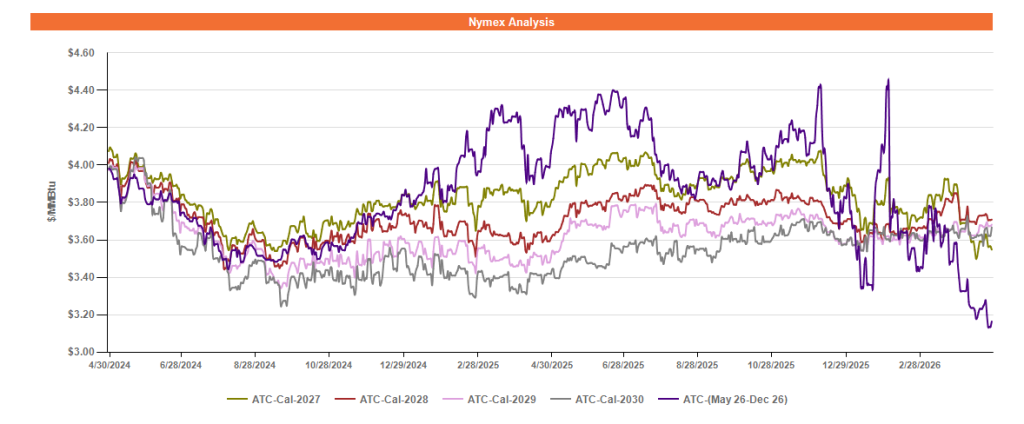
Figure 2 below shows the historical April 29, 2024 through April 29, 2026 Around the Clock (ATC) forward NYMEX natural gas prices in dollars per MMBtu for the balance of 2026 (labeled as “Custom Strip”) and calendar years 2027, 2028, 2029, and 2030.
Figure 2: ATC Calendar Year NYMEX Natural Gas Prices
*Pricing courtesy of Direct Energy Business.
Since the start of the Iran conflict in March, forward natural gas prices have moved lower, diverging from oil and gasoline, which have trended upward. This decline in gas prices can largely be attributed to four factors: the relative energy independence of the U.S., mild weather at the end of winter, strong early-season storage injections that have pushed inventory levels above the five-year average, and expectations that higher oil prices will eventually drive increased oil production, bringing additional natural gas supply with it due to associated gas from oil drilling.
Forward natural gas prices for the remainder of 2026 have declined the most, reflecting the strongest impact from these market factors. Prices for calendar years 2027 and 2028 have also trended downward, hovering at or near two-year lows. In contrast, prices beyond 2028 have been less affected, as longer-term pricing is driven more by broader fundamentals, particularly expectations for global liquefied natural gas (LNG) production and export capacity.
Electricity Market Update
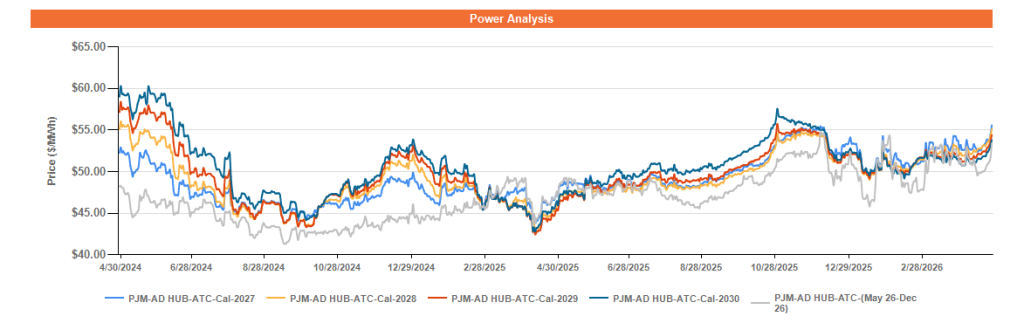
Figure 3 below shows the historical April 29, 2024 – April 29, 2026 ATC forward power prices in dollars per Megawatt hour (MWh) for the balance of 2026 (labeled as “Custom Strip”) and calendar years 2027, 2028, 2029, and 2030 for the AD Hub.
Figure 3: ATC Calendar Year Power Prices for the AD Hub
*Pricing courtesy of Direct Energy Business.
Although forward natural gas prices have softened markedly since the start of the Iran Conflict, this has not been the case in the forward power market. Forward power prices tend to be “sticky” compared to other commodities because electricity cannot be cost-effectively stored in large quantities. Data centers are contributing to large increases in load forecasts on the grid, and the resulting risk premium in forward power prices has been buoying the market across all terms, even with natural gas prices falling to two-year lows.