Ohio Energy Report: March 2026
Ohio Senate Bill 103 Takes Effect
On March 20, 2026, Ohio Senate Bill 103 (SB 103) went into effect after being signed into law by Governor Mike DeWine on December 19, 2025. SB 103 introduces structural changes to natural gas ratemaking, with a focus on large-load customer treatment, cost recovery mechanisms, and regulatory timelines. The legislation builds on reforms established under prior energy legislation and signals a continued shift toward forward-looking rate design and economic development support.
Key components of SB 103 that will impact natural gas rate design in Ohio include:
- Flexibility for large-load customers to enter into custom rate arrangements with local distribution companies, subject to approval from the Public Utilities Commission of Ohio (PUCO);
- Increased protections for existing customers from subsidizing large-load infrastructure investments;
- A shift away from gas utility rider-based recovery mechanisms and a greater reliance on base rates;
- Acceptance of forward-looking cost projections, or “forecasted test years” rather than historical test years to establish base rates;
- Redefined, accelerated PUCO deadlines for issuing orders in gas rate cases; and
- Rate case cadence that mandates utilities file rate cases at least every three years.
While SB 103 will not immediately change rates, it will influence how rates are structured, updated, and negotiated going forward, which will make proactive engagement in rate cases all the more important for commercial and industrial customers in Ohio.
Electric Distribution Utilities to File Annual Reliability Reports March 31
On January 22, 2026, the PUCO finalized a new process for annual statewide electric reliability reporting, as required under House Bill 15. The framework is intended to improve transparency into utility performance and introduces circuit-level reliability data, which is a meaningful development for large commercial and industrial (C&I) customers.
Under the new process, Ohio electric distribution utilities, including AEP Ohio (AEP), FirstEnergy (FE), AES Ohio, and Duke Energy Ohio must submit their first annual report containing detailed reliability data to the PUCO by March 31, 2026. PUCO Staff will then issue a draft statewide report for stakeholder comment before publishing a final version.
The reporting will include circuit-level outage frequency and duration metrics, identification of the worst-performing circuits and substations, and tracking of planned reliability upgrades. Circuits with “persistent reliability issues” will be defined as those ranking in the worst-performing 8% for three consecutive years, creating a clear benchmark for ongoing performance concerns.
For C&I customers, this new reporting structure provides greater visibility into localized reliability performance, enabling:
- More precise identification of outage-related risks;
- Data-driven discussions with utilities on service quality; and
- Stronger support for escalation where chronic issues exist
Customers experiencing recurring outages, such as those on consistently underperforming circuits, will now have access to the data needed to better understand and address these challenges. Brakey Energy will monitor these filings and help clients interpret results and identify opportunities to mitigate reliability risks.
Transmission Charges Changing for FirstEnergy Customers on April 1, 2026
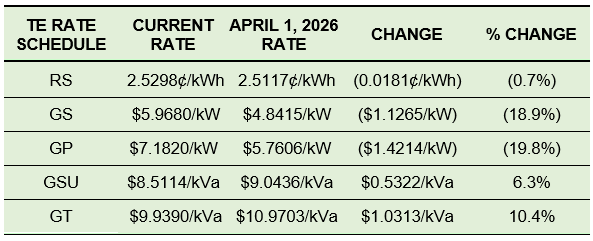
The Non-Market-Based Services Rider (Rider NMB) rates are set to change April 1, 2026 for residential and non-residential customers of FE’s three Ohio operating companies: Ohio Edison (OE), the Illuminating Company (CEI), and Toledo Edison (TE). Rider NMB recovers FE’s non-market-based costs for transmission and ancillary services, with the largest component being PJM’s Network Integration Transmission Service (NITS) charge.
Beginning April 1, the Rider NMB rate for nonresidential customers will range from $4.8415 per kW (for TE GS customers) to $10.9703 per kVa (for TE GT customers).
Current and April 1, 2026 Rider NMB rates for OE, CEI, and TE Residential (RS), Secondary (GS), Primary (GP), Subtransmission (GSU), and Transmission (GT) rate schedules are shown in the tables below. Rates are per kilowatt hour (kWh) for RS customers and per kilowatt (kW) or kilovolt-ampere (kVa) for GS, GP, GSU, and GT customers. As it often the case, there will be material variance in percent changes between the different operating companies and rate schedules.
Table 1: OE Rider NMB Rates
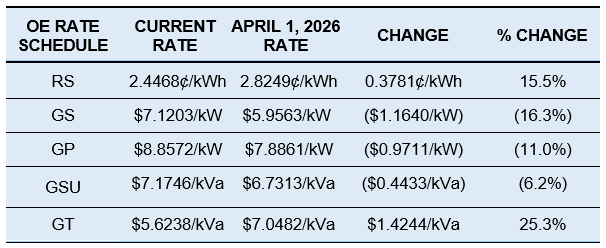
Table 2: CEI Rider NMB Rates
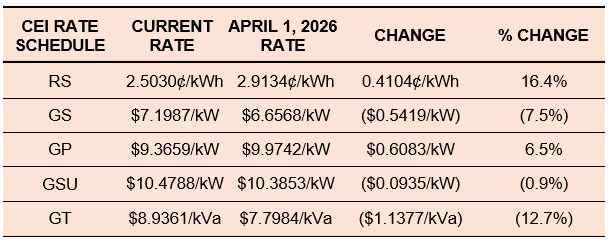
Table 3: TE Rider NMB Rates
Clients that are participating in FE’s transmission pilot program are opted out of paying the NMB rider. If you have any questions about this pilot program or how the new NMB rates will impact your electric costs, please contact Katie Emling.
AEP Ohio’s Transmission Rates Changing April 1, 2026
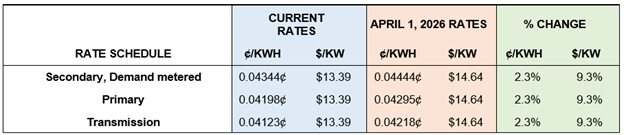
Earlier this month, the PUCO approved rate updates to take effect beginning April 1, 2026 for AEP’s Basic Transmission Cost Rider (BTCR). With the sole exception of the demand based rate for transmission voltage customers, BTCR charges will be increasing, and fairly significantly at that. We believe that it is large data center load served at the transmission voltage level that has not only kept a lid on this rate, but actually reduced it by approximately 6%.
Select interval-metered customers, including Brakey Energy clients, may have elected to participate in a transmission pilot program. For participants, the demand portion of BTCR charges is calculated based on the customer’s load during AEP’s 1CP, as opposed to the default method, which uses monthly billed demand. Demand-based BTCR rates for customers participating in AEP’s transmission pilot program will increase by approximately 9.3%.
It’s also worth noting that the demand based rate for transmission level customers in the pilot program is more than twice as high as the same rate for transmission level customers not enrolled in the pilot program. This means that the stakes are even higher for pilot customers to successfully manage their load during the AEP single coincident peak.
The tables below show the current and April 1, 2026 BTCR kWh and kW-based rates for non-transmission pilot program customers and transmission pilot program customers of AEP Ohio. The percentage change for each rate is also summarized.
Table 4: Current and April 1, 2026 BTCR Rates for AEP Ohio Customers
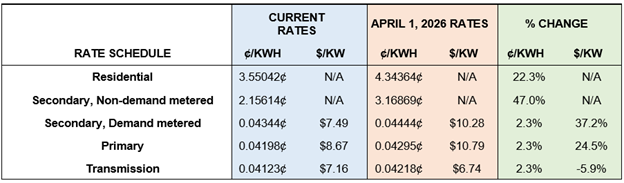
Table 5: Current and April 1, 2026 for AEP Ohio Customers Participating in the Transmission Pilot Program
If you would like more information about how the BTCR impacts your monthly electric costs, please contact Katie Emling.
Residential Corner
Sky-high capacity prices coupled with geopolitical turmoil has kept residential rates at the highest levels in recent memory. We recommend customers with an approaching contract expiration migrate to a short-term eight month offer with Dynegy for 9.09¢/kWh.
Regarding natural gas, Brakey Energy has long viewed the distribution utilities’ Standard Choice Offer (SCO) as a prudent default strategy for supply. However, this approach can produce volatile bill outcomes—like the wild ride many customers experienced during the extreme cold earlier this winter. With natural gas settlement prices easing, many of our friends on the SCO can now safely unbuckle their seatbelts, at least until we need to strap in again next winter.
Natural Gas Market Update
The NYMEX price for March settled at $2.969 per Million British Thermal Units (MMBtu) on March 27, 2026. This price is down 60% from the February 2026 price of $7.460 per MMBtu. This settlement price is used to calculate March gas supply costs for customers that contract for a NYMEX-based index gas product.
The graph below shows the year-over-year monthly NYMEX settlement prices for 2022, 2023, 2024, 2025, and 2026 year to date. Prices shown are in dollars per MMBtu of natural gas.
Figure 1: NYMEX Monthly Natural Gas Settlement Prices
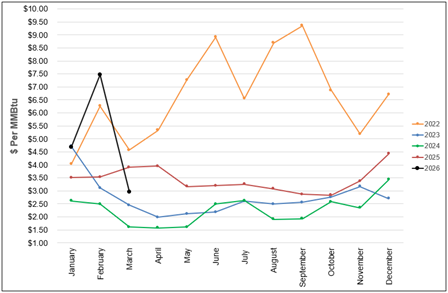
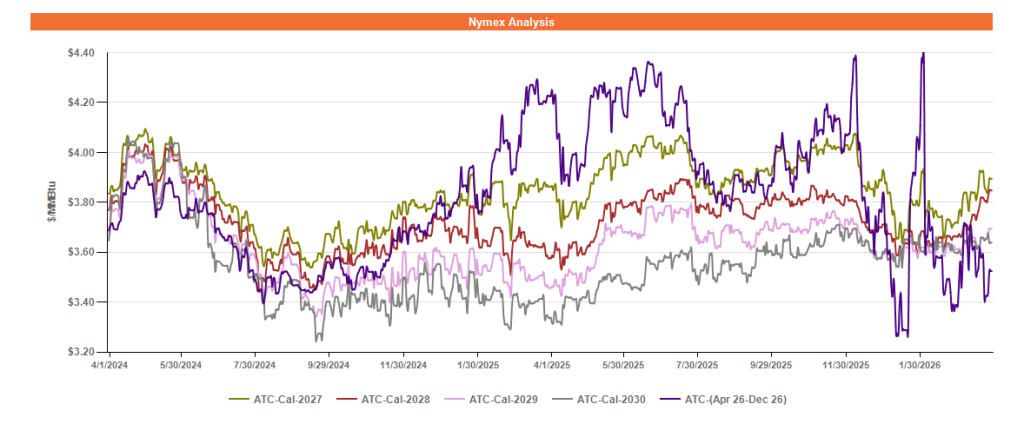
Figure 2 below shows the historical March 31, 2024 through March 31, 2026 Around the Clock (ATC) forward NYMEX natural gas prices in dollars per MMBtu for the balance of 2026 (labeled as “Custom Strip”) and calendar years 2027, 2028, 2029, and 2030.
Figure 2: ATC Calendar Year NYMEX Natural Gas Prices
*Pricing courtesy of Direct Energy Business.
Although the outbreak of war in the Middle East has wreaked havoc in global oil, gasoline, and LNG markets, volatility in the domestic natural gas market has been comparatively subdued. The United States’ relative energy independence has kept the domestic gas market insulated from the conflict’s shipping interruptions in the Strait of Hormuz. This, in combination with robust domestic production and a mild end to the winter, has helped keep a lid on forward natural gas prices.
As the war continues, elevated volatility can be expected across global energy markets, given the importance of the Strait of Hormuz to energy transportation. And, although well-insulated from the conflict, the propensity for volatility has created a risk premium in domestic natural gas prices.
Electricity Market Update
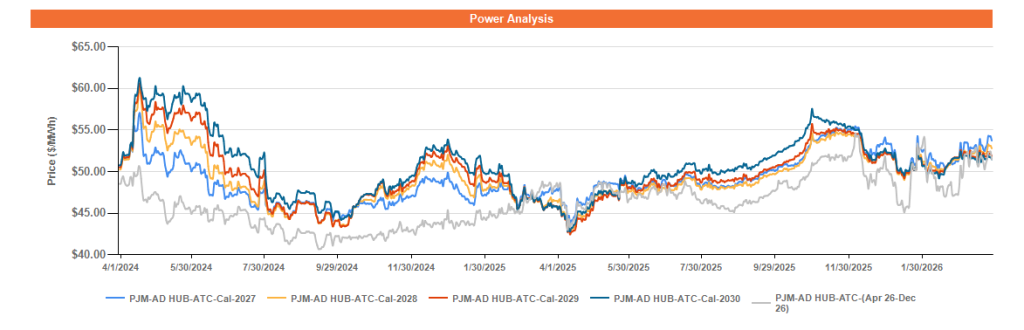
Figure 3 below shows the historical March 31, 2024 – March 31, 2026 ATC forward power prices in dollars per Megawatt hour (MWh) for the balance of 2026 (labeled as “Custom Strip”) and calendar years 2027, 2028, 2029, and 2030 for the AD Hub.
Figure 3: ATC Calendar Year Power Prices for the AD Hub
*Pricing courtesy of Direct Energy Business.
Similar to the domestic forward gas market, forward power price volatility has been subdued compared to the oil, gasoline, and LNG markets. Even so, however, forward power prices for the balance of 2026 through calendar year 2029 are trading near multi-year highs, buoyed by the same risk premium that has formed in all energy markets as a result of the war.
As we approach the summer, weather outlooks and forecasts will continue to grow in importance to the forward power market.