Ohio Energy Report: May 2026
Take Steps This Summer to Mitigate Your 2027/2028 Capacity Costs
The start of this summer’s capacity cost management period is less than one week away. For customers on generation contracts that pass through capacity charges, these charges are based on the customer’s metered demand during the five one-hour intervals when demand on PJM’s electric grid is at its highest. These intervals—known as Coincident Peaks (CPs)—typically occur during June, July, August, or September. A customer’s average demand during these CPs determines its capacity charges for the next delivery year, which runs from June 1, 2027 through May 31, 2028.
PJM’s capacity rate will increase from $270.43/Megawatt (MW)-day to $329.08/MW-day on June 1, 2026. Based on the Base Residual Auction results, the 2027/2028 Delivery Year capacity price is $333.44/MW-day. We expect prices to remain elevated in future delivery years, but capped based on the Federal Energy Regulatory Commission’s approved extension of the existing price collar.
To help manage capacity charges for the 2027/2028 delivery year, customers can take steps to reduce demand during this summer’s CPs. Brakey Energy supports these efforts through our CP alert notification system, which allows participating customers to reduce electric usage during forecasted peak periods.
We will soon be issuing a CP forecasting report to clients enrolled to receive CP alerts this summer. The report outlines historic CP trends and provides our summer peak load forecasts.
If you are not enrolled to receive these alerts and would like to participate, please email Catherine Nickoson. Please also contact Catherine to change your registration preferences, including adding or deleting which employees receive the alerts. This is a service available only to Brakey Energy clients.
Take Steps This Summer to Mitigate Your 2027 Transmission Costs
While managing capacity costs is important, many customers can achieve comparable savings through transmission cost management. Eligible FirstEnergy (FE) customers may opt out of the utility’s transmission-related riders and instead pay for transmission and related services through their certified retail electric service (CRES) suppliers, based on their Network Service Peak Load (NSPL). Participation in FE’s transmission pilot program is currently limited to customers identified in the ESP IV case, those who gained access during the brief expansion of the program under ESP V, or received approval for enrollment from a Reasonable Arrangement application with the Public Utilities Commission of Ohio.
American Electric Power (AEP) offers a similar transmission pilot program under its modified ESP III. However, unlike FE, AEP bills customers directly rather than through their CRES providers. Participation is currently limited to customers grandfathered into the program in July 2024 or those who enrolled during the December 2024 expansion under AEP’s ESP V. Customers interested in joining the program in April 2027 will have the opportunity to enroll through a first-come, first-served queue that reopens on December 1, 2026.
For FE and AEP customers currently enrolled in a transmission pilot program—or those planning to join AEP’s program in April 2027—transmission charges for next year will be based on each customer’s demand during the 2026 Transmission Coincident Peaks (CPs).
For AES Ohio non-residential customers served at primary voltage and above, as well as secondary-voltage non-residential customers who opt in, 2027 transmission charges will be based on demand during AES Ohio’s single CP set this summer.
To help reduce transmission charges, eligible FE and AEP pilot program customers—as well as applicable AES Ohio customers—can take steps to lower demand during Transmission CPs. Brakey Energy supports these efforts through our CP alert notification system. Participating clients receive alerts in advance of anticipated CPs and can reduce electric usage during those periods. This service is available exclusively to Brakey Energy clients.
If you are a participating client that would like to change your registration preferences, including adding or deleting which employees receive the alerts, please email Catherine Nickoson.
FirstEnergy Files First Three-Year Base Rate Plan with PUCO
FE and its Ohio utilities (Ohio Edison, the Illuminating Company, and Toledo Edison) filed their first-ever Three-Year Rate Plan (TYRP) with the Public Utilities Commission of Ohio (PUCO) on May 22, 2026. This application marks a significant shift in how electric distribution rates will be set in Ohio going forward.
The filing was made under Ohio’s recently enacted utility ratemaking framework via House Bill 15, which replaces traditional backward-looking rate cases with a forward-looking, multi-year approach. Instead of recovering only historical spending, utilities can now seek approval for projected investments and planned distribution system upgrades over a three-year horizon.
According to FE, the proposal is designed to support continued investment in reliability, grid modernization, vegetation management, and customer service enhancements across northern Ohio. The company said it plans to invest approximately $800 million annually in poles, wires, substations, and grid technology improvements throughout the TYRP period.
The case will now proceed through the PUCO review process including testimony, discovery, staff audits, and third-party intervention. Stakeholders will closely evaluate forecasted capital spending assumptions, reliability and outage reduction metrics, customer affordability impacts, earnings and return on equity levels, and proposed reconciliation and annual true-up mechanisms. Brakey Energy clients will be represented in this case through the Ohio Energy Leadership Council.
A final PUCO decision is expected sometime in 2027, with approved rates likely phased in annually over the three-year plan period.
Ohio Energy Leadership Summit to Take Place on June 16, 2026 in Cleveland
The inaugural Ohio Energy Leadership Summit: The Definitive Commercial & Industrial Utility Rate and Energy Strategy Conference will take place on Tuesday, June 16 at the Hilton Cleveland Downtown (100 Lakeside Avenue East, Cleveland, Ohio 44114).
The conference is scheduled to kick off at 8:45 AM and conclude at 6:00 PM. It will feature keynote perspectives, executive utility panels, and focused breakout sessions covering critical topics including grid reliability, distribution investments and rate cases, PJM market developments, natural gas supply trends, and strategies for managing energy costs in an evolving regulatory environment.
The program is designed for commercial and industrial energy consumers and is presented by the Ohio Energy Leadership Council, with sponsorship support from BakerHostetler and Dynegy (powered by Vistra).
Brakey Energy team members will be participating in three workshops or interactive panels during the conference.
You can view the full agenda, speaker lineup, and register through the conference event page. Brakey Energy clients and members of the Ohio Energy Leadership Council will receive complimentary registration. Other large energy users are able to access discounted registration. If you’re interested in attending, feel free to reach out to Catherine Nickoson for the registration code.

Residential Corner
Sky-high capacity prices coupled with geopolitical turmoil has kept residential rates at the highest levels in recent memory. We recommend customers with an approaching contract expiration migrate to a 12-month offer with AEP Energy for 9.39¢/kWh.
Regarding natural gas, Brakey Energy has long viewed the distribution utilities’ Standard Choice Offer (SCO) as a prudent default strategy for supply. However, this approach can produce volatile bill outcomes—like the wild ride many customers experienced during the extreme cold earlier this winter. With natural gas settlement prices easing, many of our friends on the SCO can now safely unbuckle their seatbelts, at least until we need to strap in again next winter.
Natural Gas Market Update
The NYMEX price for May settled at $2.559 per Million British Thermal Units (MMBtu) on April 28, 2026. This price is down 17.3% from the April 2026 price of $3.095 per MMBtu. This settlement price is used to calculate May gas supply costs for customers that contract for a NYMEX-based index gas product.
The graph below shows the year-over-year monthly NYMEX settlement prices for 2022, 2023, 2024, 2025, and 2026 year to date. Prices shown are in dollars per MMBtu of natural gas.
Figure 1: NYMEX Monthly Natural Gas Settlement Prices
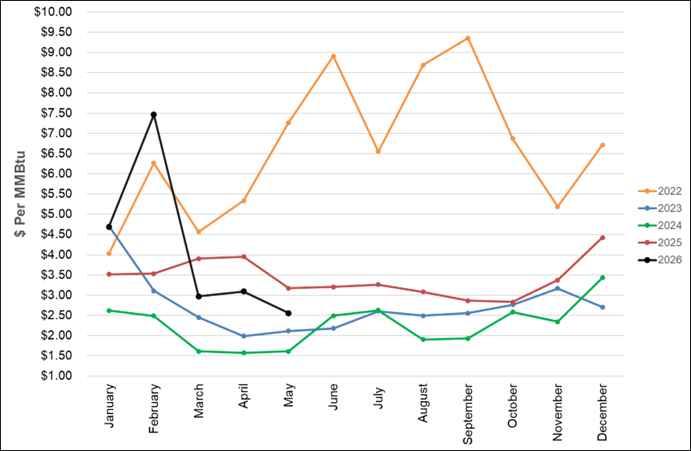
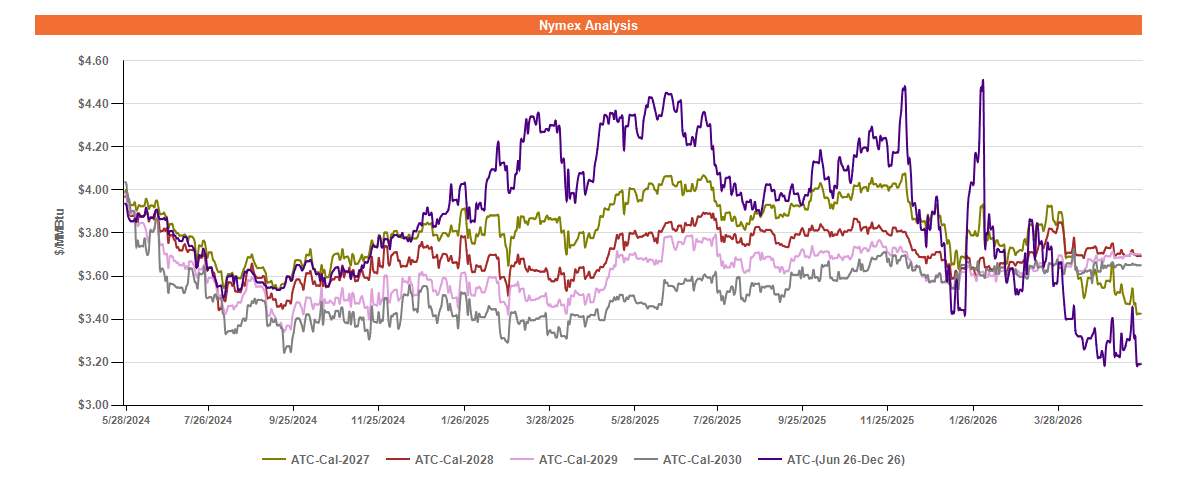
Figure 2 below shows the historical May 27, 2024 through May 27, 2026 Around the Clock (ATC) forward NYMEX natural gas prices in dollars per MMBtu for the balance of 2026 (labeled as “Custom Strip”) and calendar years 2027, 2028, 2029, and 2030.
Figure 2: ATC Calendar Year NYMEX Natural Gas Prices
*Pricing courtesy of Direct Energy Business.
Forward natural gas prices over the past month have been little changed overall, for both the short-term and long-term. Domestic production has eased off the all-time highs that were observed over the winter, but remains robust. Meanwhile, liquefied natural gas (LNG) exports have reached new records as the Golden Pass export hub has come online and steadily increases its export capacity.
Market participants across all energy markets are paying close attention to developments in the Iran Conflict and the potential re-opening of the Strait of Hormuz, which has effectively been shuttered since the conflict began in early March. The potential for elevated volatility in the forward gas market (and all energy markets) remains as the conflict continues.
Electricity Market Update
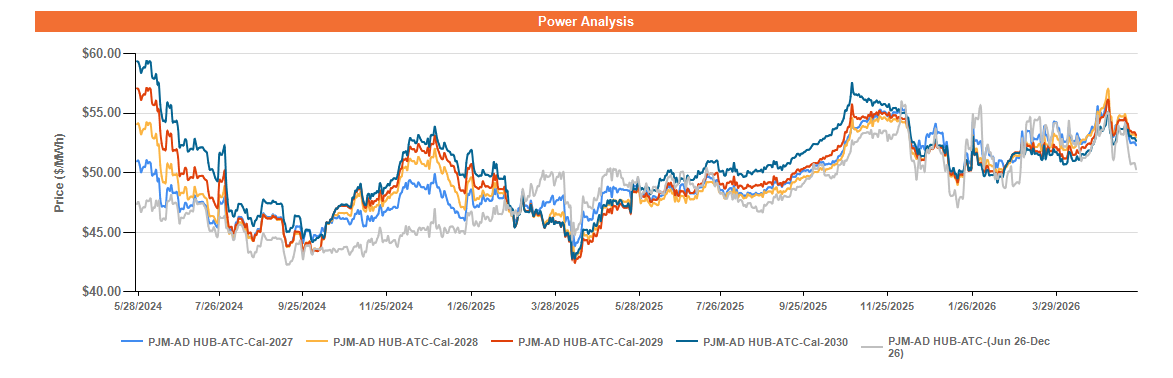
Figure 3 below shows the historical May 27, 2024 – May 27, 2026 ATC forward power prices in dollars per Megawatt hour (MWh) for the balance of 2026 (labeled as “Custom Strip”) and calendar years 2027, 2028, 2029, and 2030 for the AD Hub.
Figure 3: ATC Calendar Year Power Prices for the AD Hub
*Pricing courtesy of Direct Energy Business.
Forward power prices have broken their correlation to forward natural gas prices in recent weeks; while forward gas has traded down since the start of the Iran Conflict, forward power prices have been little changed overall – though they have softened from the recent multi-year highs seen in April. Forward power prices tend to be “sticky” compared to other commodities because electricity cannot be cost-effectively stored in large quantities.
As we progress into summer, market participants will be analyzing load and weather forecasts as data center load is expected to have a sizeable impact on grid conditions – a fundamental factor that has likely contributed to forward power prices continuing to trade with a risk premium compared to forward gas.