Ohio Energy Report: July 2026
PJM BRA Again Clears at Price Cap, Backstop Auction Being Planned for September
On July 14, PJM released the results of its Base Residual Auction for the June 1, 2028 through May 31, 2029 delivery year. The auction cleared at the federally approved price cap of $325.00 per MW-day across the entire PJM footprint, including Ohio’s utility zones. This equates to approximately $118.63 per kW-year and is approximately 2.5% below the prior planning year’s capped clearing price of $333.44 per MW-day.
PJM procured approximately 138,318 MW of unforced capacity, but the auction still fell roughly 6,831 MW short of PJM’s reliability requirement. The shortfall reflects continued load growth, particularly from large-load customers, combined with limited new generation entering the market. Only about 317 MW of new generation and 208 MW of uprates cleared the auction, reinforcing concerns that supply is not keeping pace with projected demand.
Without the temporary price cap, PJM estimated that the auction would have cleared at approximately $554.72 per MW-day across most of the region, while the ComEd Zone (encompassing Chicago and Northern Illinois) would have cleared at approximately $776.69 per MW-day. The value of capacity commitments would have increased from about $16.4 billion to nearly $29.7 billion. Although suppliers may have bid differently without the cap, the simulation illustrates the gravity of PJM’s current supply-and-demand imbalance.
To address the shortfall, PJM is planning a one-time reliability backstop procurement, with bidding expected to begin in September. The procurement is intended to attract incremental generation, storage and demand-side resources that may not otherwise be developed through the normal auction process. However, the program remains subject to FERC approval, and because most new resources require several years to develop, it is unlikely to provide an immediate solution to PJM’s capacity shortage.
Peak Loads for Summer 2026
Brakey Energy provides email and text alerts in advance of potential Capacity and Transmission Coincident Peaks (CPs) to those clients that elect to receive them. As of July 29, 2026, Brakey Energy has issued 7 Capacity CP alerts, 8 FE (ATSI Zone) Transmission CP alerts, and 6 AEP Ohio CP alerts during Summer 2026. Brakey Energy also issued 7 winter alerts for the AEP Zone in January and February of this year.
Capacity CPs occur during the five one-hour intervals when demand on the PJM grid is at its highest. Transmission CPs for FE customers occur during the five one-hour intervals when demand on FE’s zonal grid is at its highest. The Transmission CP for AEP customers occurs during the one-hour interval when demand on AEP’s zonal grid is at its highest.
The tables below list PJM’s and FE’s five highest loads and AEP’s single highest load this year, as well as the day and time of each occurrence. This is based on preliminary data.
Table 1: Five Highest Loads for PJM through July 29, 2026
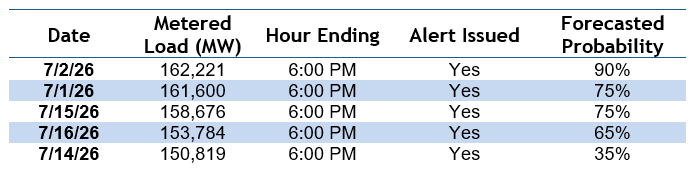
Table 2: Five Highest Loads for ATSI Zone through July 29, 2026
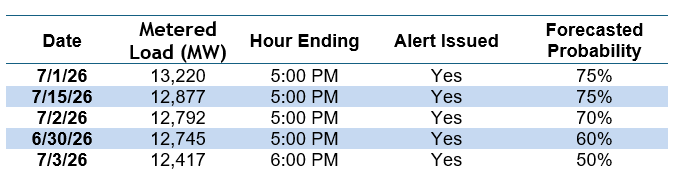
Table 3: Single Highest Load for AEP Zone through July 29, 2026

The summer CP season ends on September 30, which is still more than two months away. However, we believe there is a strong probability that many of the PJM and ATSI loads listed in the tables above – particularly the top three – will be CPs at the end of summer. Similarly, there is a strong likelihood that AEP’s load on July 1, 2026 will set AEP Zone’s 1CP for the November 1, 2025, through October 31, 2026 CP year.
Brakey Energy will continue monitoring weather and load forecasts and will issue alerts to participating clients as warranted. If you are a Brakey Energy client and would like to receive these alerts, please contact Catherine Nickoson.
AES Ohio Files Stipulation and Recommendation in First Forecasted Rate Case
On July 21, 2026, AES Ohio, PUCO Staff, and 16 other parties filed an unopposed Stipulation and Recommendation (“Stipulation”) with the Public Utilities Commission of Ohio (PUCO) that would resolve the utility’s three-year rate plan proceeding for 2027 through 2029. If approved, the settlement would increase AES Ohio’s annual distribution revenue requirement by approximately $124.0 million in 2027, $30.5 million in 2028, and $21.3 million in 2029.
Bill impacts are expected to be moderate since several existing riders would be rolled into base distribution rates and reset to zero beginning January 1, 2027. The resulting rates would remain subject to annual true-ups based on AES Ohio’s actual investments, revenues, and expenses.
Of particular importance to commercial and industrial customers, the Stipulation would establish a new Curtailable Use Reliability Benefit (CURB) Program that would commence on January 1, 2028. CURB, modeled after FirstEnergy’s Economic Load Response Program Rider, would provide qualifying energy-intensive customers with a monthly credit of $6.00 per kW of curtailable load, less a $150 monthly administrative charge, in exchange for reducing load during emergency curtailment events called by AES Ohio or PJM.
For purposes of R.C. 4909.192(A), an ‘energy-intensive customer’ was recently defined as one that meets any one of the following qualifications: (i) the customer has billing demand greater than 25 MW at a single location, (ii) self-assesses the kWh tax under R.C. 5727.81, or (iii) has peak demand in excess of 1 MW and can curtail or self-generate over 70% of its monthly peak electricity demand within 120 minutes.
CURB program capacity would be capped pro-rata at 25 MW during 2028 and would increase to 50 MW during 2029. Data center tariff customers would not be eligible except through a separate PUCO-approved reasonable arrangement.
If you have any questions about AES Ohio’s Stipulation or the CURB program awaiting PUCO approval, please contact Katie Emling.
Residential Corner
Sky-high capacity prices coupled with increased data center demand have kept residential rates at the highest levels in recent memory. We recommend customers with an approaching contract expiration migrate to a 6-month offer with Direct Energy for 9.09¢/kWh.
Regarding natural gas, Brakey Energy has long viewed the distribution utilities’ Standard Choice Offer (SCO) as a prudent default strategy for supply. However, this approach can produce volatile bill outcomes, like the wild ride many customers experienced during the extreme cold this past winter. With natural gas settlement prices since remaining reasonable, and the commodity itself trading at compelling values relative to power, customers on the SCO are likely seeing manageable bills.
Natural Gas Market Update
The NYMEX price for July settled at $3.231 per Million British Thermal Units (MMBtu) on June 26, 2026. This price is up 6.3% from the June 2026 price of $3.040 per MMBtu. This settlement price is used to calculate July gas supply costs for customers that contract for a NYMEX-based index gas product.
The graph below shows the year-over-year monthly NYMEX settlement prices for 2022, 2023, 2024, 2025, and 2026 year to date. Prices shown are in dollars per MMBtu of natural gas.
Figure 1: NYMEX Monthly Natural Gas Settlement Prices
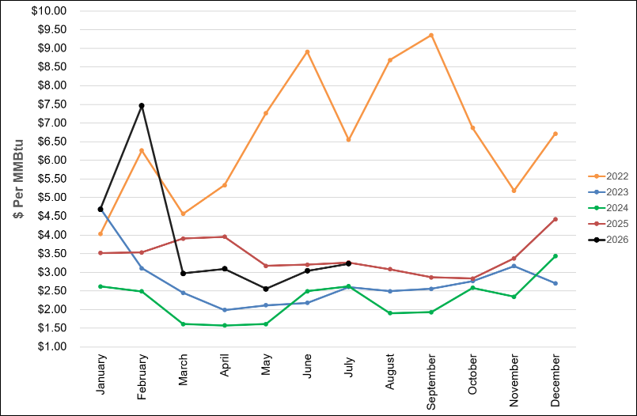
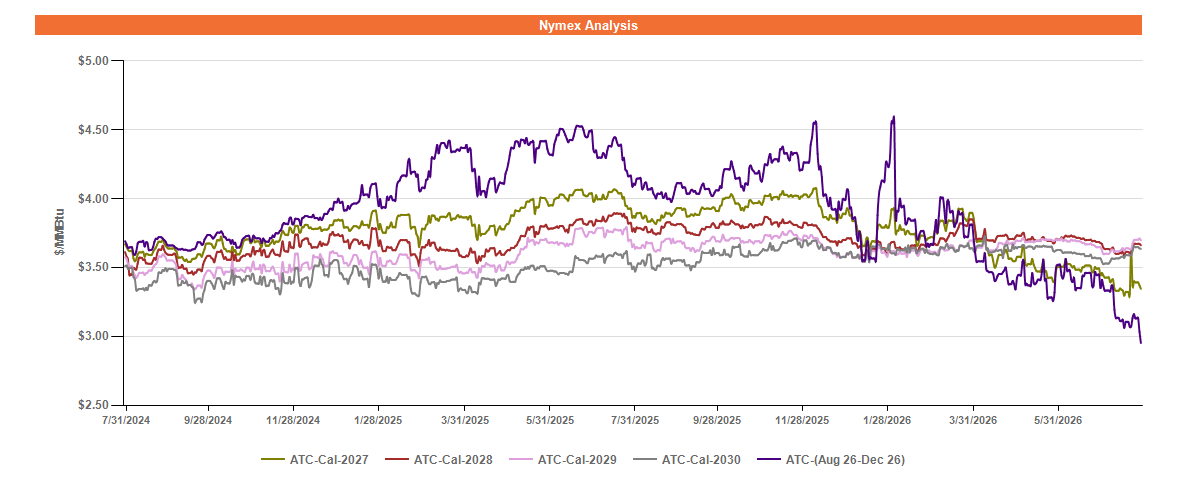
Figure 2 below shows the historical July 30, 2024 through July 30, 2026 Around the Clock (ATC) forward NYMEX natural gas prices in dollars per MMBtu for the balance of 2026 (labeled as “Custom Strip”) and calendar years 2027, 2028, 2029, and 2030.
Figure 2: ATC Calendar Year NYMEX Natural Gas Prices
*Pricing courtesy of Direct Energy Business.
The forward natural gas market remains in a pronounced state of contango through the balance of 2026 and into calendar year 2029. Strong domestic production and temporary maintenance-related outages at key Liquefied Natural Gas (LNG) export facilities have helped soften forward prices through 2027, while outer years have remained relatively flat.
Although much of the country has experienced record-setting heat this summer, forward natural gas prices have continued to trend lower, as domestic natural gas demand (excluding LNG exports) has remained generally in line with prior summers. Combined with robust production, this lack of meaningful demand growth has contributed to continued softness in the forward market through 2027.
Electricity Market Update
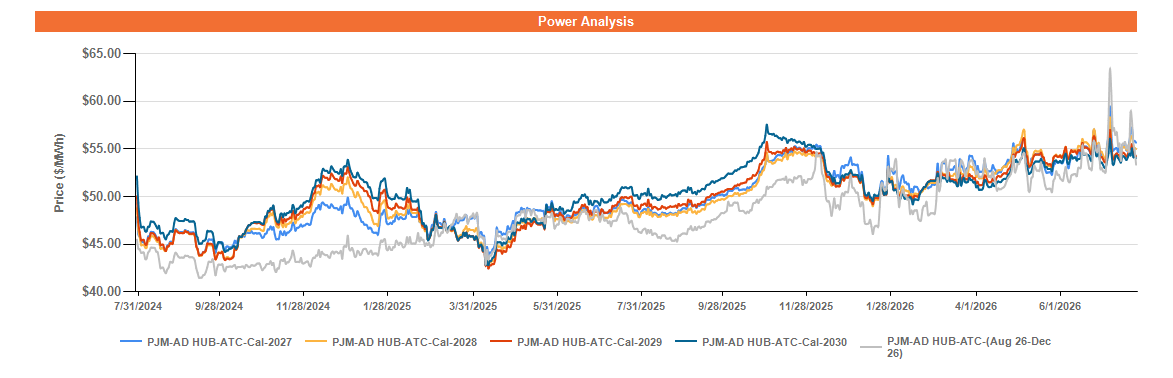
Figure 3 below shows the historical July 30, 2024 through July 30, 2026 ATC forward power prices in dollars per Megawatt hour (MWh) for the balance of 2026 (labeled as “Custom Strip”) and calendar years 2027, 2028, 2029, and 2030 for the AD Hub.
Figure 3: ATC Calendar Year Power Prices for the AD Hub
* Pricing courtesy of Direct Energy Business.
Over the course of 2026, the forward power market has largely decoupled from the forward natural gas market. This breakdown in the historical correlation between the two markets reflects a widening imbalance between rapidly growing electricity demand and the pace of new gas-fired generation development.
When forecasted PJM grid demand exceeds 150 GW, PJM has been increasingly forced to dispatch higher-cost generation resources and, at times, demand response to maintain system reliability. Extreme spot prices have resulted from this imbalance, and forward power prices have traded higher as a result.
The capacity price cap discussed above may be amplifying this dynamic. When the capacity auction clears at an administratively capped price, the scarcity value the cap suppresses does not disappear. Rather, revenue that suppliers would typically recoup through the capacity market appears to be leaking into the energy market, with sellers reflecting that shortage value in forward energy prices.
Because PJM must rely on higher-cost resources to serve the last increment of load during the highest-demand hours, forward power prices have not softened alongside forward natural gas prices. Instead, the forward power market has retained a significant risk premium, reflecting uncertainty surrounding future supply adequacy as large new loads continue to seek interconnection while new generation additions lag behind. Consequently, forward power prices have become increasingly sensitive to demand forecasts as well as weather forecasts and patterns, while becoming less responsive to movements in the natural gas market.