Ohio Energy Report: August 2026
A Tightening Grid Sends Summer Spot Prices Past $1,000/MWh
The rapid growth in power demand, driven largely by data centers, has strained PJM’s existing generation fleet during periods of extreme summer weather. During the early- and mid-July heat waves this year, demand on the grid approached available system capacity, forcing PJM to rely on its most expensive generation resources—and at times demand response—to serve the final increment of load.
On July 2, PJM system-wide day-ahead spot prices exceeded $1,000/MWh ($1.00/kWh). Some of the most constrained load zones, such as the Baltimore Gas & Electric Zone (BGE), saw spot power prices peak at approximately $1,600/MWh, due to high congestion costs associated with importing power into the zone from elsewhere on the grid.
Outside of these periods of grid stress, spot prices have cleared at much more reasonable levels, though the impact of rising demand is still evident. So far in August, as temperatures have moderated, PJM system-wide hourly spot prices have averaged 5.05¢/kWh. That compares with 3.85¢/kWh over the same period in 2025—a 31% increase—when much of the anticipated data center demand had yet to materialize on the grid.
With the last month of summer still in front of us, and a surprise heat wave on our doorstep, we will wait and see how spot prices react.
PJM’s Reliability Backstop Procurement and Proposed Large Load Registry
As discussed in last month’s newsletter, PJM has proposed a Reliability Backstop Procurement (RBP) to address the 6,831 megawatt (MW) capacity shortfall from its 2028/2029 Delivery Year Base Residual Auction. Pending approval from the Federal Energy Regulatory Commission (FERC), the RBP process would begin September 30.
PJM has also proposed a Large Load Registry (LLR) that would track end-use customers—data centers or otherwise—with cumulative peak demand of 50 MW or greater at a delivery point or point of interconnection. Existing Large Loads in service before June 1, 2027, would generally be required to register by March 1, 2027.
For most small and mid-sized commercial and industrial (C&I) customers, the registry itself creates no direct obligation. The risk is downstream: if the Large Load designation later becomes the basis for allocating RBP costs or other reliability obligations, existing Ohio manufacturers could end up as the financial backstop for load growth they did not cause.
That risk prompted the Ohio Energy Leadership Council (OELC) to intervene in PJM’s RBP proceeding in FERC Docket No. ER26-3380-000. OELC’s comments support PJM’s resource-adequacy objective, but urge protections for existing customers: a 150 MW threshold for non-data-center loads, measurement based on system-peak Peak Load Contribution rather than individual peaks, and a demonstrable link between a customer’s load and the growth driving the RBP. OELC also pressed PJM to prioritize dispatchability, duration, and fuel assurance when selecting RBP resources.
Brakey Energy will continue to monitor PJM’s RBP proceeding and the proposed LLR, particularly as they relate to potential costs for Ohio C&I customers. If you have questions, please contact Katie Emling.
Residential Corner
Sky-high capacity prices coupled with increased data center demand have kept residential rates at the highest levels in recent memory. We recommend customers with an approaching contract expiration migrate to this 9-month fixed-rate offer from Energy Harbor for 9.59¢/kWh.
Regarding natural gas, Brakey Energy has long viewed the distribution utilities’ Standard Choice Offer (SCO) as a prudent default strategy for supply. However, this approach can produce volatile bill outcomes, like the wild ride many customers experienced during the extreme cold this past winter. With natural gas settlement prices having since remained reasonable, and the commodity itself trading at compelling values relative to power, customers on the SCO are likely seeing manageable bills.
Natural Gas Market Update
The NYMEX price for August settled at $2.725 per Million British Thermal Units (MMBtu) on July 29, 2026. This price is down 15.7% from the July 2026 price of $3.231 per MMBtu. This settlement price is used to calculate August gas supply costs for customers that contract for a NYMEX-based index gas product.
The graph below shows the year-over-year monthly NYMEX settlement prices for 2022, 2023, 2024, 2025, and 2026 year to date. Prices shown are in dollars per MMBtu of natural gas.
Figure 1: NYMEX Monthly Natural Gas Settlement Prices
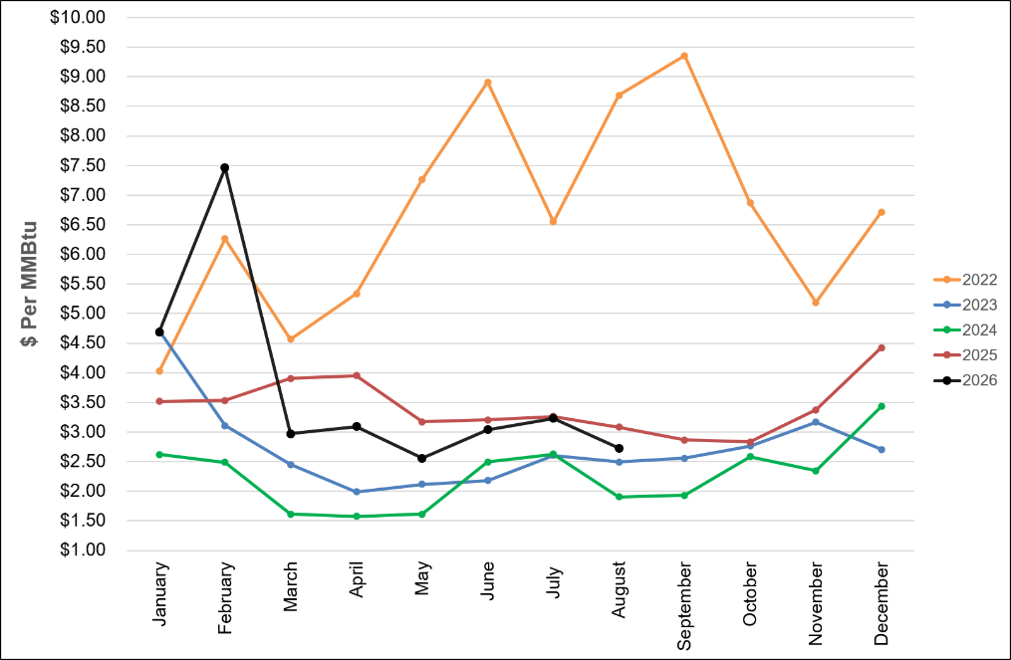
Figure 2 below shows the historical August 28, 2024 through August 28, 2026 Around the Clock (ATC) forward NYMEX natural gas prices in dollars per MMBtu for the balance of 2026 (labeled as “Custom Strip”) and calendar years 2027, 2028, 2029, 2030, and 2031.
Figure 2: ATC Calendar Year NYMEX Natural Gas Prices
*Pricing courtesy of Direct Energy Business.
Forward natural gas prices have continued to trade at or near multi-year lows through 2027, and have largely traded flat for outlier years 2028 and beyond. Although total demand for natural gas has been higher this summer than the previous two summers, due to increased LNG export capacity and higher power burn demand, domestic production has remained robust and near all-time highs.
As we transition from summer to autumn, market participants will be looking to early winter weather outlooks and forecasts, which could reintroduce volatility to the forward gas market.
Electricity Market Update
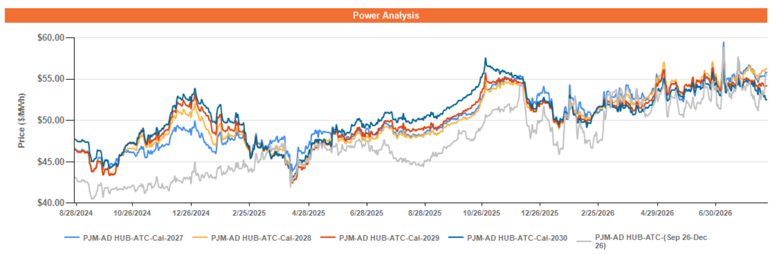
Figure 3 below shows the historical August 28, 2024 through August 28, 2026 ATC forward power prices in dollars per Megawatt hour (MWh) for the balance of 2026 (labeled as “Custom Strip”) and calendar years 2027, 2028, 2029, and 2030 for the AD Hub.
Figure 3: ATC Calendar Year Power Prices for the AD Hub
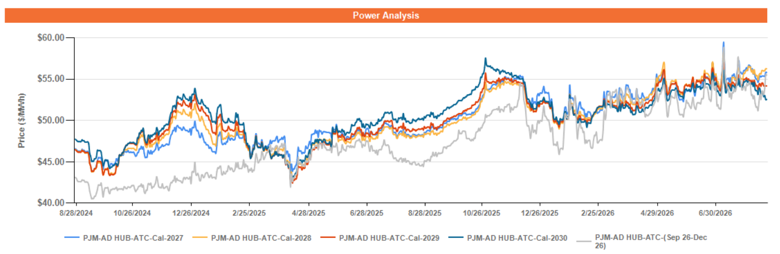
*Pricing courtesy of Direct Energy Business.
Forward power prices continue to trade near multi-year highs, principally due to the unpredictable impact of future weather events on spot power prices, the constrained grid conditions amidst the fast-paced growth of large data center loads, and the extension of the capacity price cap through the 2029/2030 delivery year.
Although forward power prices have not followed forward gas prices downward, movements in forward gas prices can still influence forward power prices, as gas-fired generation accounts for approximately 40% of all electric generation in PJM. As autumn approaches, market participants will be paying close attention to early winter weather outlooks, which may bring increased volatility to energy markets.