Ohio Energy Report: November 2026
Take Steps This Winter to Mitigate Your Transmission Costs
Eligible electric customers in the service territories of FirstEnergy (FE), AES Ohio, and Ohio Power Company (“Ohio Power”) – formerly known as AEP Ohio – can reduce their transmission costs by lowering demand on specific days when load peaks across a transmission zone. These peak hours are known as Transmission Coincident Peaks (Transmission CPs). Under transmission pilot programs, customers are charged for transmission based on their demand during these hourly Transmission CPs, rather than the default method, which uses monthly billed demand.
For the 2028 calendar year, transmission charges for transmission pilot program customers will be based on their demand during the Transmission CPs that occur in the 12 months ending October 31, 2027. Historically, Transmission CPs in the FE and AES Ohio service territories have occurred exclusively during the summer. In contrast, the single-hour CP (1 CP) in the AEP Zone has also occurred during winter months.
Over the past ten years, half of the AEP Zone’s 1 CP events have taken place in the winter. In four of those five years, the 1 CP occurred during the hour ending (HE) 8:00 AM or 9:00 AM Eastern Standard Time (EST).
We recommend that Ohio Power customers currently enrolled in Ohio Power’s transmission pilot program take steps this winter to curtail load in response to potential Transmission CPs, especially during HE 8:00 AM and HE 9:00 AM EST on potential 1 CP days.
To support customers in reducing demand during Transmission CPs, Brakey Energy has developed an alert notification system. This service is available only to Brakey Energy clients. Participating clients can modify their registration preferences by emailing Catherine Nickoson.
Changes Expected to PIPP Rider on January 1
Earlier this month, Ohio Power, FE, AES Ohio, and Duke Energy Ohio (“Duke”) filed applications to adjust each utility’s Percentage of Income Payment Plan (“PIPP”) Rider. These applications were filed to the Public Utilities Commission of Ohio (PUCO) to implement statewide reforms of the Universal Service Fund Rider, which was replaced by the PIPP Rider on January 1, 2026. The PIPP Rider is designed to recover each electric distribution utility’s (EDU) share of funding for low-income assistance programs administered by the Ohio Department of Job and Family Services, along with prudently incurred costs of administering the program.
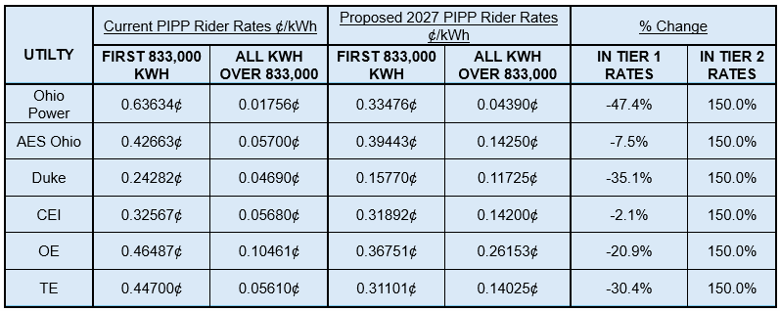
Each EDU has proposed to maintain the two-block declining-block rate design that has been in effect since October 1999. One rate is billed for the first 833,000 kilowatt-hours (kWh) consumed each month and a second rate is billed for all monthly kWh consumed over 833,000 kWh.
However, to manage the bill impacts to residential and small commercial customers, each EDU has proposed to increase the second-rate block that has remained unchanged since 1999 by 150%. Furthermore, since Ohio Power currently has a Data Center Tariff (DCT) and AES Ohio expects to have its DCT go into effect on January 1, 2027, these two EDUs have proposed to charge DCT customers the higher first-block rate for all kWh consumed each month. If such proposals are approved by the PUCO, we would expect to see similar rate structures proposed by FE and Duke once they have active DCTs.
The table below summarizes each EDU’s current and proposed PIPP Rider rates that if approved as filed would go into effect on January 1, 2027.
Table 1: Current and Proposed PIPP Rider Rates for Ohio Electric Customers
If you have any questions about how you may be impacted by the proposed PIPP Rider rates, please contact Katie Emling.
PJM Revises Special Capacity Auction Proposal
On October 29, 2026, PJM Interconnection submitted a revised proposal to the Federal Energy Regulatory Commission (FERC) for its one-time Reliability Backstop Procurement (RBP), commonly referred to as the special capacity auction. The proposal is intended to address the 6,831-megawatt (MW) capacity shortfall identified in PJM’s 2028/2029 Base Residual Auction. Following an administrative correction, PJM refiled the proposal on November 9 under FERC Docket No. ER27-454-000.
Under the revised proposal, PJM would begin the special procurement process in March 2027, with results expected in May. The amount of additional capacity procured would be recalculated using updated load forecasts and available generation resources and could be lower than the originally identified 6,831 MW shortfall. The proposal would allow contracts of up to 15 years and establish a maximum willingness to pay based on a weighted average of $555/MW-day.
A key revision concerns how the costs of the special auction would be allocated. Rather than spreading costs broadly across existing customers, PJM proposes allocating costs based on incremental large-load growth within each transmission zone. The revised filing also reduces collateral requirements for electricity suppliers and clarifies how financial obligations would be handled when customers change suppliers.
For Ohio commercial and industrial customers, the primary concern remains whether the costs of procuring additional capacity to support rapidly growing large loads will be passed along to existing customers. PJM has requested a FERC decision by January 29, 2027, with implementation contingent upon regulatory approval.
Residential Corner
Sky-high capacity prices, outsized load growth, and frequent grid emergencies have kept generation prices at the highest levels in recent memory. We recommend customers with an approaching contract expiration migrate to a six-month fixed-rate offer from Better Buy Energy for 9.89¢/kWh. Unlike last month where we highlighted a longer-term offer, the best value is currently on the short end of the market.
Regarding natural gas, Brakey Energy has long viewed the distribution utilities’ Standard Choice Offer (SCO) as a prudent default strategy for supply. However, this approach can produce volatile bill outcomes, like the wild ride many customers experienced during the extreme cold this past winter. With natural gas settlement prices having since remained reasonable, and the commodity itself trading at compelling values relative to power, customers on the SCO are likely seeing manageable bills.
Natural Gas Market Update
The NYMEX price for November 2026 settled at $2.817 per Million British Thermal Units (MMBtu) on October 28, 2026. This price is down 6.1% from the October 2026 price of $3.000 per MMBtu. This settlement price is used to calculate November gas supply costs for customers that contract for a NYMEX-based index gas product.
The graph below shows the year-over-year monthly NYMEX settlement prices for 2022, 2023, 2024, 2025, and 2026 year to date. Prices shown are in dollars per MMBtu of natural gas.
Figure 1: NYMEX Monthly Natural Gas Settlement Prices
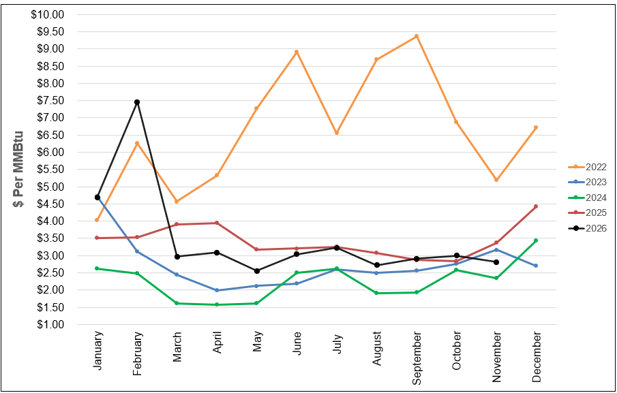
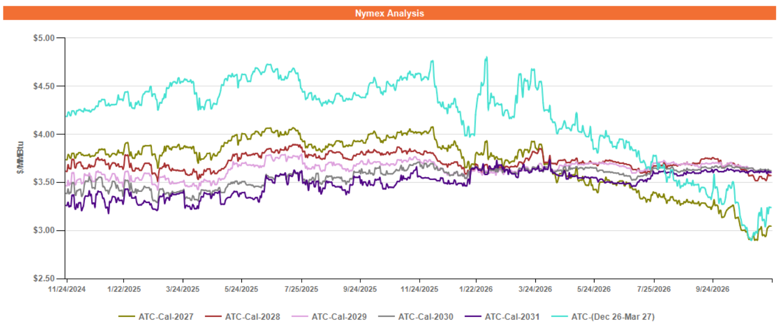
Figure 2 below shows the historical November 24, 2024 through November 24, 2026 Around the Clock (ATC) forward NYMEX natural gas prices in dollars per MMBtu for the Winter 2026-2027 strip of December 2026 through March 2027 and calendar years 2027, 2028, 2029, 2030, and 2031.
Figure 2: ATC Calendar Year NYMEX Natural Gas Prices
*Pricing courtesy of Direct Energy Business.
Forward gas prices have mostly continued trading lower, though the recent cold front has brought a small spike in prices for the Winter ‘26/’27 strip and calendar year 2027. There has been softness in calendar year 2028, while outlier years continue to trade mostly flat.
Market participants have priced in the expectation of a mild winter resulting from the strong El Niño event, healthy storage levels heading into the winter, and the expectation that fresh all-time high gas production levels will be observed in Q1 of 2027. However, as we are quickly approaching winter, weather forecasts will likely contribute to higher price volatility than what has been seen over the past six months, particularly for prices in 2027.
Electricity Market Update
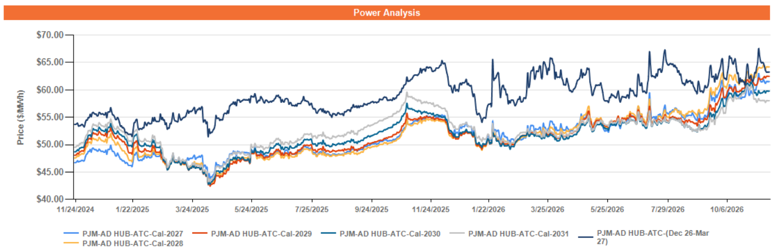
Figure 3 below shows the historical November 24, 2024 through November 24, 2026 ATC forward power prices in dollars per Megawatt hour (MWh) for the Winter 2026-2027 strip of December 2026 through March 2027 and calendar years 2027, 2028, 2029, and 2030 for the AD Hub.
Figure 3: ATC Calendar Year Power Prices for the AD Hub
* Pricing courtesy of Direct Energy Business.
Following the sweeping Democrat victories at both the state and federal levels in the mid-term elections, the forward power market has begun to bifurcate into two time periods that have different fundamental factors impacting prices: the late 2020s and the early 2030s.
Forward power prices in the early 2030s have softened since the mid-term elections due to market participants’ expectations that the Democrats will move to draft legislation limiting the further development of data centers, which could reduce load demand growth on the grid. Additionally, more generation resources are expected to come online beginning in the early 2030s, which could help alleviate the current supply-demand imbalance.
Forward power prices for the late 2020s, however, have traded higher since the mid-term elections. Additional generation resources are still several years away from being completed, and, in the wake of the Democrat victories, market participants are pricing in the risk that buildout of data centers could be pushed forward more quickly to be under construction or completed before any potential legislation is enacted that may limit further development. The risk of increased load growth above previous forecasts for the late 2020s has led to an overall increase in forward power prices for these years.