Ohio Energy Report: October 2026
Columbia Gas of Ohio Proposes Three-Year Rate Plan with Significant Rate Increases
On October 19, 2026, Columbia Gas of Ohio (“Columbia”) filed an application with the Public Utilities Commission of Ohio (PUCO) seeking approval of a three-year rate plan covering January 1, 2028, through December 31, 2030. The Application, filed in Case No. 26-0965-GA-AIR, requests annual revenue increases of approximately $158.8 million (9.37%) in 2028, $103.2 million (5.53%) in 2029, and $89.3 million (4.50%) in 2030, net of the elimination of certain existing capital recovery riders, along with a 10.25% return on equity.
Columbia would also eliminate its Infrastructure Replacement Program (IRP), PHMSA IRP, and Capital Expenditure Program riders and roll those investments into base distribution rates. It proposes two new riders: a Base Rate Reconciliation Rider to true up forecasted and actual revenues, investments, and expenses, and an Underground Line Locating Rider.
Of particular importance to commercial and industrial (C&I) customers, Columbia proposes expanding its three nonresidential rate classes (Small General Service, General Service, and Large General Service) into six, with new annual usage thresholds. Table 1 summarizes the proposed classes.
Table 1: Columbia’s Proposed C&I Rate Classes
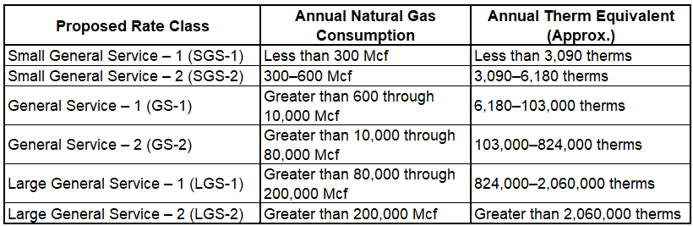
Bill impacts for individual C&I customers will depend on their usage, rate classification, and the rates the PUCO ultimately approves, and the application remains subject to review and modification before new rates take effect in 2028. Brakey Energy will continue monitoring the proceeding, particularly the proposed nonresidential rate classifications, cost allocations, and resulting bill impacts.
OELC Advocates for New Interruptible Program in Duke Energy Ohio Rate Case
On October 21, 2026, Brakey Energy President Matt Brakey submitted Direct Testimony on behalf of the Ohio Energy Leadership Council (OELC) in Duke Energy Ohio’s (“Duke”) pending electric distribution base rate case (PUCO Case No. 26-0132-EL-AIR). Matt recommended that the PUCO require Duke to establish a new nonresidential interruptible program or substantially modify its existing Peak Load Management Program (Rider PLM).
Duke’s existing Rider PLM allows eligible customers to receive financial incentives for reducing electricity demand but lacks standardized credits and clearly defined curtailment conditions. Matt recommended a program modeled after FirstEnergy’s Economic Load Response Program (Rider ELR), with transparent participation requirements, predictable compensation, and clearly defined interruption obligations. Specifically, he proposed monthly credits of no less than $10 per kilowatt (kW) of committed curtailable demand, with a minimum credit floor pegged to PJM capacity prices.
Matt emphasized the growing importance of flexible demand-side resources as PJM’s supply-and-demand balance tightens. Through October 21, PJM had activated demand response resources serving Ohio on six dates in 2026, including several events in September and October when system demand was well below summer peak levels.
These events demonstrate the need for reliable curtailment resources beyond traditional summer peak periods. A utility-administered interruptible program could provide Duke with additional resources to support grid reliability while creating meaningful cost-saving opportunities for participating commercial and industrial customers.
FirstEnergy’s SSO Rates Increased Slightly on October 1
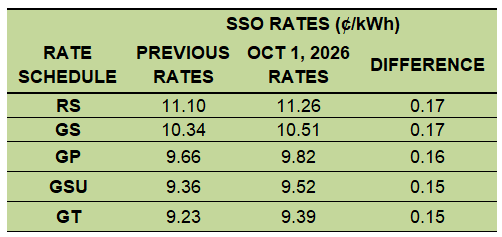
Electric costs increased slightly on October 1 for Ohio Edison (OE), The Illuminating Company (CEI), and Toledo Edison (TE) customers that take electric generation service under the utilities’ Standard Service Offer (SSO). The SSO is the default rate charged by the utility for generation services to customers that do not contract with an alternative supplier.
The previous and October 1, 2026 SSO rates per kilowatt hour (kWh) for customers served under OE, CEI, and TE Residential (RS), Secondary (GS), Primary (GP), Subtransmission (GSU), and Transmission (GT) rate schedules are shown in the tables below. These rates will change again on January 1, 2027.
Table 2: OE SSO Rates
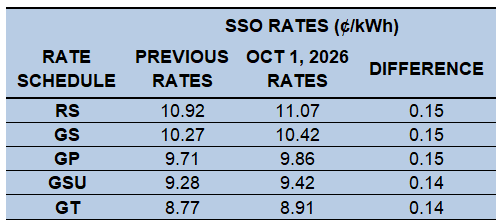
Table 3: CEI SSO Rates
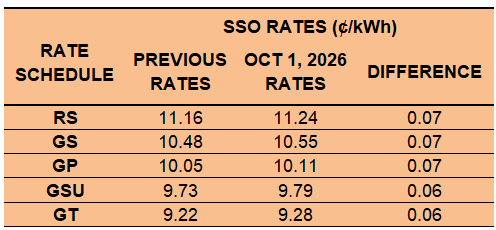
Table 4: TE SSO Rates
If you are not receiving electric generation service from an alternative supplier and would like more information about how FirstEnergy’s SSO rate update will impact your monthly electric costs, please contact Katie Emling.
Residential Corner
Sky-high capacity prices, outsized load growth, and frequent grid emergencies have kept generation prices at the highest levels in recent memory. We recommend customers with an approaching contract expiration migrate to a 36-month fixed-rate offer from Better Buy Energy for 10.89¢/kWh. This will give longer term price certainty with no early termination fee, so customers can move to a different offer if prices retreat.
Regarding natural gas, Brakey Energy has long viewed the distribution utilities’ Standard Choice Offer (SCO) as a prudent default strategy for supply. However, this approach can produce volatile bill outcomes, like the wild ride many customers experienced during the extreme cold this past winter. With natural gas settlement prices having since remained reasonable, and the commodity itself trading at compelling values relative to power, customers on the SCO are likely seeing manageable bills.
Natural Gas Market Update
The NYMEX price for October settled at $3.00 per Million British Thermal Units (MMBtu) on September 28, 2026. This price is up 3.2% from the September 2026 price of $2.907 per MMBtu. This settlement price is used to calculate October gas supply costs for customers that contract for a NYMEX-based index gas product.
The graph below shows the year-over-year monthly NYMEX settlement prices for 2022, 2023, 2024, 2025, and 2026 year to date. Prices shown are in dollars per MMBtu of natural gas.
Figure 1: NYMEX Monthly Natural Gas Settlement Prices
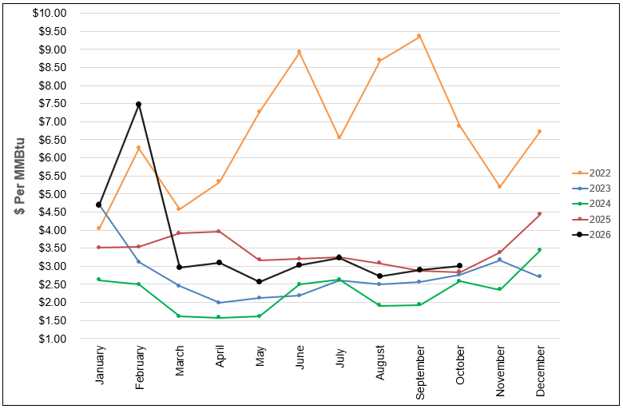
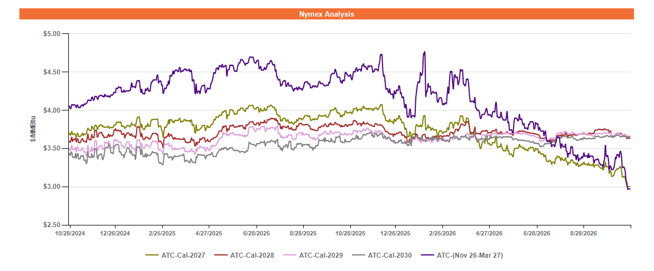
Figure 2 below shows the historical October 28, 2024 through October 28, 2026 Around the Clock (ATC) forward NYMEX natural gas prices in dollars per MMBtu for the Winter 2026-2027 strip of November 2026 through March 2027 and calendar years 2027, 2028, 2029, 2030, and 2031.
Figure 2: ATC Calendar Year NYMEX Natural Gas Prices
*Pricing courtesy of Direct Energy Business.
Forward natural gas prices have continued to soften through Calendar Year 2027 but have still traded rangebound and mostly flat month-over-month for Calendar Years 2028 and beyond.
Continued strong production, healthy storage figures, and the expectation of a mild winter due to a predicted very strong El Niño event have all contributed to continued softness in prices through 2027. Forward natural gas prices can become volatile, however, if unexpected and unseasonably cold temperatures enter forecasts.
Electricity Market Update
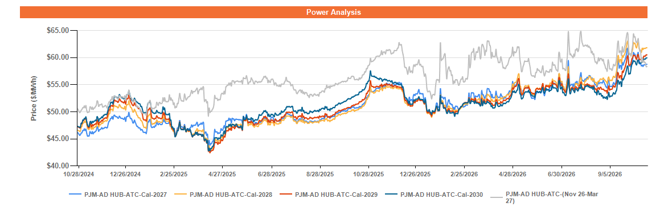
Figure 3 below shows the historical October 28, 2024 through October 28, 2026 ATC forward power prices in dollars per Megawatt hour (MWh) for the Winter 2026-2027 strip of November 2026 through March 2027 and calendar years 2027, 2028, 2029, and 2030 for the AD Hub.
Figure 3: ATC Calendar Year Power Prices for the AD Hub
* Pricing courtesy of Direct Energy Business.
Forward power prices remain volatile as PJM, state and federal regulators, end-users, and market participants all continue to evaluate the current supply-demand imbalance and reliability concerns on the grid. Prices across the forward curve have traded markedly higher following demand response events that took place earlier in October when system-wide peak demand was only forecasted to reach approximately 112 GW, raising concerns that such events may now be called at times of year when they never were before.
However, there has been some recent softness in short-term forward power prices for the upcoming winter and for the first half of 2027, largely in response to continued mild weather forecasts in the short term and the continued softness in the forward gas market for 2027. Although power prices have always been sensitive to changes in grid conditions and weather forecasts, they have become even more sensitive to these phenomena in the wake of the demand response events called over the previous two months, and this is expected to continue for the foreseeable future.